Introduction
Customer support plays a major role in how customers view your business.
When customers have questions, need assistance, or encounter problems, they expect timely responses. Long wait times can lead to frustration, negative reviews, and lost trust.
The challenge for many small businesses is that support requests often arrive faster than they can be answered.
As a business grows, customer emails, support tickets, and service requests can quickly become overwhelming.
The good news is that improving support response times does not always require hiring additional staff. With better processes and AI-assisted tools, businesses can respond faster while maintaining quality customer service.
Why Customer Support Response Times Matter
Customers want to know that their questions are being heard.
Whether they are asking about a product, requesting help with an order, or reporting an issue, timely communication helps build confidence and trust.
Slow response times often create frustration.
In many cases, customers are not expecting immediate solutions. They simply want acknowledgment that someone is working on their request.
Businesses that consistently respond quickly often create better customer experiences and stronger customer relationships.
Common Causes of Slow Support Response Times
High Email Volume
As businesses grow, customer emails can quickly pile up.
Questions about orders, invoices, passwords, services, and technical issues often arrive throughout the day.
Without a system in place, inboxes can become difficult to manage.
Repetitive Questions
Many support teams answer the same questions repeatedly.
- Where is my order?
- How do I reset my password?
- Can I change my plan?
- How do I update my account?
- How do I contact support?
Writing similar responses over and over consumes valuable time.
Limited Staff Resources
Small businesses often have limited personnel handling support requests.
When support responsibilities are combined with sales, operations, and administration, response times can suffer.
Practical Ways to Improve Response Times
Create a Knowledge Base
Providing answers to common questions can reduce the number of support requests your team receives.
Documentation, tutorials, and frequently asked questions help customers solve simple problems on their own.
Use Response Templates
Templates can dramatically reduce the time required to answer common inquiries.
Support agents can start with a prepared response and personalize it when necessary.
Organize Requests by Priority
Not every support request requires the same level of urgency.
Organizing inquiries by priority helps ensure critical issues receive attention first.
How AI Can Help
Artificial intelligence can help businesses handle repetitive support tasks more efficiently.
Rather than replacing support staff, AI can assist by drafting responses, summarizing customer inquiries, and helping support teams respond faster.
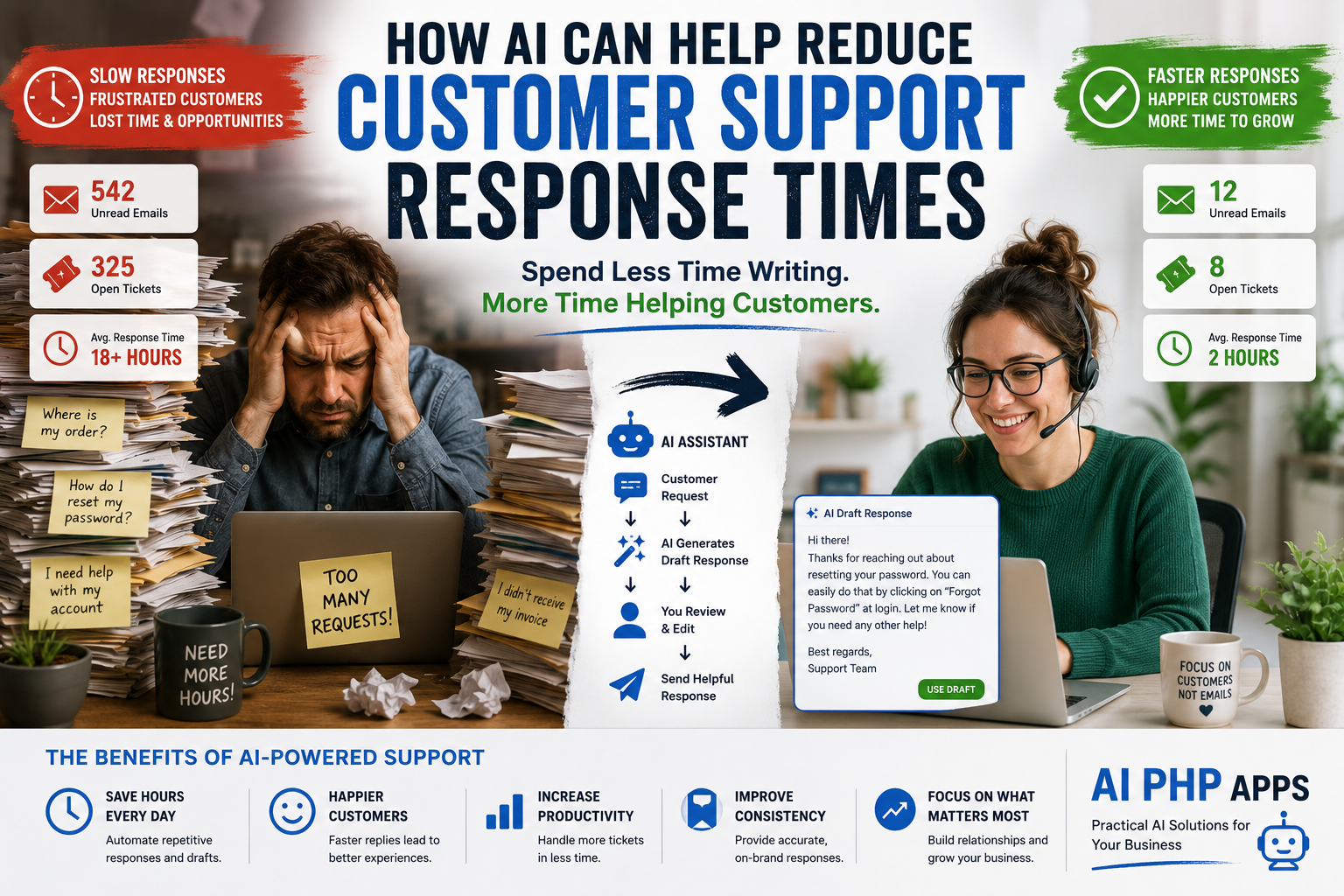
A typical workflow might look like this:
- Customer submits a support request.
- AI analyzes the request.
- AI drafts a response.
- A support agent reviews the draft.
- The response is sent to the customer.
This approach reduces repetitive writing while allowing businesses to maintain quality control.
For organizations receiving frequent support inquiries, the time savings can be substantial.
When Human Review Still Matters
AI can assist with drafting responses, but human oversight remains important.
Businesses should carefully review responses involving:
- Billing questions
- Refund requests
- Account changes
- Technical troubleshooting
- Customer complaints
The goal is faster communication while maintaining professionalism, accuracy, and customer trust.
Benefits of Faster Customer Support
Reducing support response times can provide several benefits:
- Improved customer satisfaction
- Stronger customer relationships
- Increased team productivity
- Better customer retention
- More time for business growth activities
Customers appreciate businesses that communicate clearly and respond promptly.
Even small improvements in response times can have a positive impact on the customer experience.
Using AI to Assist Customer Support
Businesses that regularly handle support emails can benefit from tools designed specifically for support workflows.
An AI-powered support assistant can help draft responses, summarize customer messages, and reduce the amount of time spent writing repetitive replies.
The final response remains under your control, but the drafting process becomes much faster.
This allows your team to spend more time helping customers and less time rewriting similar responses.
Frequently Asked Questions
Can AI replace customer support agents?
No. AI is best used as an assistant that helps draft responses and reduce repetitive work. Human review remains important.
Will AI respond automatically to customers?
That depends on how a business chooses to implement it. Many businesses prefer reviewing drafts before responses are sent.
Can AI help with email support?
Yes. AI can summarize customer emails, suggest responses, and reduce the time required to answer common questions.
Do small businesses benefit from AI-assisted support?
Absolutely. Small businesses often have limited support resources, making time savings especially valuable.
What is the biggest benefit of reducing support response times?
Improved customer satisfaction and stronger customer relationships are often the most significant benefits.
Final Thoughts
Customer support is one of the most important ways businesses build trust with their customers.
Improving response times does not require a complete overhaul of your support process. Small improvements such as better organization, templates, documentation, and AI-assisted drafting can help businesses respond faster while maintaining quality service.
The goal is not to replace people.
The goal is to spend less time writing repetitive responses and more time helping customers.